
"coffee consumption statistics"
500 article(s) found

China is expected to become the most potential coffee consumer in the world.
Coffee, as a traditional western drink, has a long history and cultural heritage. The world consumes at least 400 billion cups of coffee every year, and the current annual global coffee consumption is about 10 million tons. Coffee is the first of the three largest drinks in the world, and it is also the second largest trading commodity in the world after oil. Shanpu consulting industry analyst pointed out that the world coffee consumption is about one year larger than cocoa and tea.

Get an overview of the coffee industry
Coffee, as a traditional western drink, has a long history and cultural heritage. The world consumes at least 400 billion cups of coffee every year, and the current annual global coffee consumption is about 10 million tons. Coffee is the first of the two largest drinks in the world, and it is also the second largest trading commodity in the world after oil. China's coffee industry has been introduced and developed with the development of reform and opening up.

Chinese millennials love coffee more than tea, Nestl é and Starbucks are optimistic about growth potential.
Professional baristas Please pay attention to the Coffee Workshop (Wechat official account cafe_style) although Chinese people are traditionally used to drinking tea, more and more young millennials go to coffee shops rather than teahouses, thinking it is more comfortable. Large coffee chains, including Starbucks (SBUX-US), have noticed this change in consumption trends. According to Peng

China Coffee Market: Scale 70 Billion Industry Distorts Off Commercial Track
According to popular market statistics, China's coffee consumption market reached 70 billion yuan in 2015, and is exploding at an annual growth rate of 15%, reaching a trillion yuan scale by 2025. Paradoxically, the market size of 70 billion yuan, the market growth rate of 15%, such a booming industry, why does capital despise it? For this reason, the internal reference gentleman specially asked several senior capitalists for advice.

Is it wise for coffee shops to gather in shopping malls?
Coffee has risen from a cup of drink to a cultural symbol. Under the infiltration of coffee culture, coffee brands speed up horse racing enclosure this year. The latest statistics from the Beijing Business Research Institute show that China's coffee market is entering an unprecedented period of rapid development, including Starbucks, Kashijia, Coffee and other brands will open more than 1000 new coffee stores in the Chinese market. North

Why doesn't capital like 70 billion of China's coffee market?
According to the popular statistics in the market, the size of China's coffee consumption market reached 70 billion in 2015, and it is breaking out at an annual growth rate of 15%, reaching a trillion yuan by 2025. Paradoxically, why is capital dismissive of a thriving industry with a market size of 70 billion and a market growth rate of 15 per cent? To this end, Nei Shenjun specifically asked several senior capitalists.
Analysis of China Coffee Consumption Market in 2015
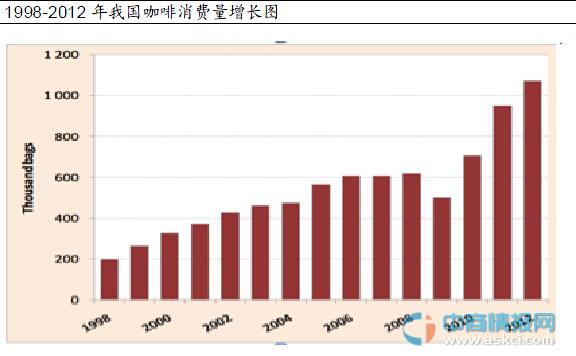
1. Changes in coffee drinking volume and drinking structure in China: compound 13% growth, instant-ready to drink-fresh grinding From 1998 to 2012, coffee consumption in China increased from 199,000 bags to 1.1 million bags, with an annual growth rate of about 12.8%. China has a population of about 1.3 billion, and coffee consumption has risen from 9.6 grams to 47.6 grams, with an average annual growth rate of about 12.1%. If the growth rate of 12.8% is maintained, the deadline

The coffee industry is booming all over the world-consuming big data to find out the development of the coffee industry.
In China, although the coffee industry started relatively late, various types of cafes blossom in China, releasing their own coffee charm. It can be said that Beijing, Shanghai and Guangzhou is a good area for the development of the domestic coffee industry, and the coffee consumption in these places still lags far behind that of the world. It can be seen that the development potential of the domestic coffee industry is still relatively large, and there is a lot of room for development.

General situation of Coffee Industry basic knowledge of boutique coffee
Coffee, as a traditional western drink, has a long history and cultural heritage. The world consumes at least 400 billion cups of coffee every year, and the current annual global coffee consumption is about 10 million tons. Coffee is the first of the two largest drinks in the world, and it is also the second largest trading commodity in the world after oil. China's coffee industry has been introduced and developed with the development of reform and opening up.

Cat poop coffee bean species wild Robusta and captive Arabica milk bubble generator to be inserted
In 1880, the British brought coffee to Taiwan. After more than 100 years, Taiwan has had little visibility on the world coffee map, and coffee beans have not been Taiwan's main cash crop. But what is interesting is that Taiwan's coffee consumption has been growing year after year over the past decade or so. According to industry and official statistics, Taiwan imported 6800 metric tons of coffee beans in 2001.

Coffee Health US study finds that drinking coffee helps prevent skin cancer
Topical or oral use of caffeine has a preventive effect on skin cancer caused by excessive sun exposure, according to a US study. A study by the university of Washington in Seattle found that drinking one cup of caffeinated coffee a day reduced the risk of skin cancer by 5%, while decaffeinated coffee had no effect. Although caffeine helps prevent skin cancer, sun protection still needs to be done. Statistics show that

Analysis on the consumption situation and Market scale trend of Coffee Industry in China
Coffee is the top three drinks in the world. Green coffee is a perennial evergreen shrub or small tree of Rubiaceae. It is a horticultural perennial cash crop, mainly distributed in Latin every week, Central and West Asia, Middle East and South Asia and other countries. Daily coffee is made from coffee beans combined with a variety of cooking utensils, and coffee beans refer to the nuts in the fruit of a coffee tree, and then use appropriate

Basic knowledge of boutique coffee general situation of coffee industry
Coffee, as a traditional western drink, has a long history and cultural heritage. The world consumes at least 400 billion cups of coffee every year, and the current annual global coffee consumption is about 10 million tons. Coffee is the first of the two largest drinks in the world, and it is also the second largest trading commodity in the world after oil. China's coffee industry has been introduced and developed with the development of reform and opening up.
Fine Coffee General knowledge International Coffee Organization History
In the 19th century, coffee became an important commodity in the international trade market. For a long time after that, the coffee market was often in a state of oversupply, low prices, and occasional price increases in short supply, but for a short period of time. During the economic crisis of the 1930s and World War II (1939-1945), the coffee market

Production and export of coffee in Latin America
Guatemala is the world's fifth largest coffee producer and exporter (Indonesia ranks fourth). Guatemala's National Coffee Association estimates coffee exports for the current year (November 1, 2005-October 30, 2006) to be 3.5 million bags (an average of 60 kilograms per bag), one million fewer than in the previous year. Colombia is the world's third largest coffee producer and
The Survival Logic of like shit Coffee
August 29th is a big day for Puyahong. On this day, Yunnan Zhonghe Coffee Co., Ltd., which he had operated for many years, landed in the Shanghai Stock Exchange Center and became the first Chinese coffee industry company to be successfully listed on the Shanghai Stock Exchange. In China, agriculture is generally regarded as a weak industry. For a long time, agricultural products (000061, stock bar) have low added value and low remuneration for agricultural production.

China's coffee consumption has grown at an annual rate of 20%-much higher than the global growth rate of 2%.
In 2008, Huang Wenguang chose to enter Nankeng Reclamation Coffee Manor in Zhangzhou, Fujian Province, and began to grow local coffee. In his view, coffee is squeezing into the Chinese market, which is dominated by tea culture, and if coffee is to be truly successful in China, there must be a coffee bean that is more suitable for the Chinese population, and a local coffee brand with more Chinese characteristics is needed, on the one hand, the market demand for

As a traditional western drink, how does coffee develop in the Chinese market?
Coffee, as a traditional western drink, has a long history and cultural heritage. The world consumes at least 400 billion cups of coffee every year, and the current annual global coffee consumption is about 10 million tons. Coffee is the first of the two largest drinks in the world, and it is also the second largest trading commodity in the world after oil. China's coffee industry has been introduced and developed with the development of reform and opening up.

Even a large number of coffee closed shop tracking: how about two deals an hour with coffee?
Professional coffee knowledge exchange more coffee bean information please follow the coffee workshop (Wechat official account cafe_style) 1 hour, no restaurant customers, two takeout orders this is the afternoon of February 28th, Beijing Lian Coffee Ganjiakou shop sales situation. Since 2017, Internet coffee represented by Luckin Coffee and Lian Coffee has begun to hit the domestic coffee market. Starbucks, a traditional coffee giant,
History of the International Coffee Organization
In the 19th century, coffee became an important commodity in the international trade market. For a long time after that, the coffee market was often in a state of oversupply, low prices, and occasional price increases in short supply, but for a short period of time. During the economic crisis of the 1930s and during World War II (1939-1945), the coffee market supply